


From Orphan Black to The Prisoner, there are plenty of forgotten sci-fi shows just waiting to be rediscovered. In the sci-fi genre in particular, there seems to be just as many unsung cult classics as there are mainstream hits.
For every Severance that finds a wide audience, there’s a Firefly that got canceled before its time. There are a ton of awesome sci-fi shows that keep getting better and better.
Killjoys

Although it quietly ran for five seasons, Killjoys never got the love it deserved. Killjoys focuses on the coolest corner of the sci-fi universe: space pirates. The series revolves around a trio of badass bounty hunters as they chase their targets around a four-planet system known as “The Quad,” and their various tragic pasts come back to haunt them.
Killjoys is basically a Judge Dredd story set in space, revolving around a group of stoic, neutral government agents with almost unlimited power. It’s arguably a better Boba Fett show than The Book of Boba Fett — it’s certainly a lot truer to the icy-cool, gunslinging Boba Fett spirit.
The Outer Limits

In most circles, The Outer Limits is dismissed as a lesser cousin of The Twilight Zone. Like Rod Serling’s game-changing masterpiece, it’s an anthology series telling a succession of gonzo sci-fi and horror stories, but it’s not an overt social commentary like Serling’s show.
The Twilight Zone was all about allegorizing contemporary social and political issues, whereas The Outer Limits was just about telling a good self-contained story. But it had brilliant writing, complete with mind-blowing twist endings in just about every episode, so it’s just as captivating as The Twilight Zone, even if it’s not quite as sociopolitically relevant.
Farscape

While CGI effects tend to age like milk, especially on TV shows where they didn’t have a huge VFX budget (remember when the CDC got blown up in The Walking Dead’s season 1 finale?), practical effects are timeless. The alien makeup and prosthetics that The Jim Henson Company created for Farscape look just as amazing today as they did back then.
The Creature Shop’s animatronics transport us to another world, but the roguish hero’s pop culture references help to ground Farscape’s zany intergalactic adventures in a relatable reality. The only downside to Farscape is that, due to its abrupt cancelation before the planned fifth and final season went into production, it ends on a cliffhanger. But it’s a heck of a ride.
The Hitchhiker’s Guide To The Galaxy

Douglas Adams’ The Hitchhiker’s Guide to the Galaxy is one of the cornerstones of sci-fi satire. Adams’ literary masterwork is a fiercely original, deeply thought-provoking piece of hard science fiction, and a laugh-out-loud piece of dry British comedy. Although the book was considered to be unfilmable, writer John Lloyd and director-producer Alan J.W. Bell turned it into a TV classic.
With razor-sharp writing, spot-on casting, and inventive filmmaking, this BBC miniseries deftly translates its iconic source material to the screen. There have been other adaptations of the guide, to varying degrees of success, but this TV show remains the best of the bunch.
12 Monkeys
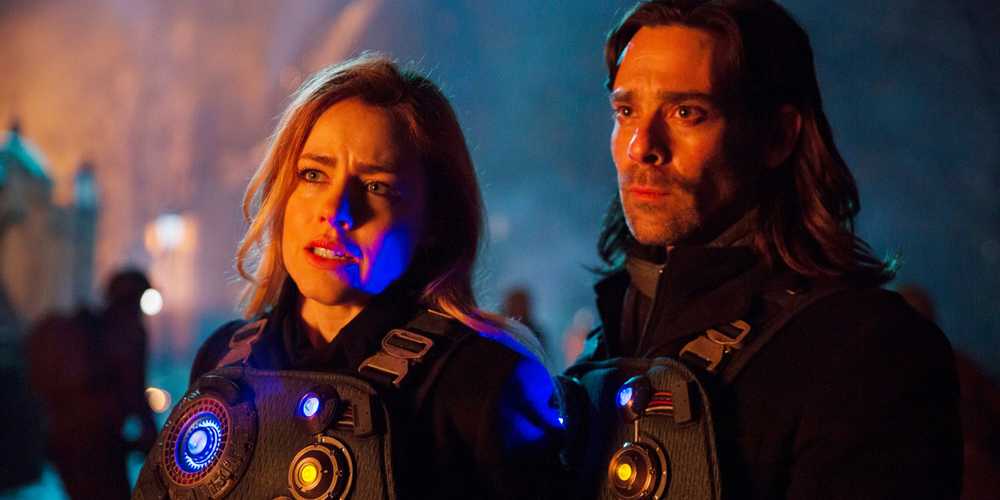
Loosely based on Terry Gilliam’s movie of the same name, 12 Monkeys is one of the most spectacular (and underappreciated) time travel shows in recent memory. Much like the movie, the TV series follows a grizzled antihero who’s sent back in time from a post-apocalyptic future to prevent the creation of a manmade virus that will decimate the human race.
With a lot more time at its disposal, the 12 Monkeys TV show was able to flesh out its characters, explore the story’s profound themes in more depth, and dig into the complexities of the time-traveling paradoxes. Split between two different timelines, 12 Monkeys constructs its multi-season narrative arc like no other show out there.
Battlestar Galactica

Ronald D. Moore’s reboot of Battlestar Galactica is a rare reboot that far outshines the original series. The original Battlestar Galactica, which aired back in 1978, was just another shallow knockoff riding the post-Star Wars wave with Moonraker, Battle Beyond the Stars, and Star Trek: The Motion Picture. But in the reboot, Moore took the bones of that original series and turned it into something important and meaningful.
The reboot used the conflict between the human race and their own diabolical creation, the Cylons, as a timely allegory for the United States’ War on Terror. All these years later, it feels allegorical of any number of subsequent conflicts that America has been involved in. Battlestar Galactica is the quintessential work of military science fiction; it takes place in outer space, but it has a lot to say about the futility of warfare.
Red Dwarf

The formula that Star Trek popularized — Wagon Train to the stars, following a ragtag ensemble across the cosmos in their tightknit spaceship — is great for dramas, like Firefly or The Orville, but it’s also a solid setup for a comedy, like Futurama. Red Dwarf is the crowning achievement of this very specific sci-fi sitcom subgenre.
Red Dwarf is the perfect intersection between character-driven comedy and concept-driven sci-fi. There’s an Odd Couple dynamic at the show’s core, with two characters who hate each other forced to co-exist while stranded together in deep space, but the futuristic setting opens the door for all kinds of speculative storylines and plot devices.
Orphan Black

The pilot episode of Orphan Black has one of the best hooks I’ve ever seen. It opens with a woman witnessing her own doppelgänger’s death, and then stealing the doppelgänger’s identity. From there, she stumbles upon a widespread conspiracy involving dozens of clones of herself. It grabs your attention right away, and never lets up.
It starts off as a sci-fi conspiracy thriller, but it becomes a touching story of sisterhood as these clones become a sort of found family. Tatiana Maslany gives one of the greatest performances in television history as all of these clones. They all have completely distinctive personalities and mannerisms and vocal cadences, and when they’re all in the same scene, you forget you’re watching just one actor.
Cowboy Bebop

In the late ‘90s, Cowboy Bebop became one of the first anime projects to reach a western audience. In fact, it became the “gateway anime” for many western viewers. Nearly three decades later, Cowboy Bebop still holds up as a television masterpiece, regardless of genre or format.
This tale of a ragtag group of space cowboys chasing bounties across the galaxy is a vibrant, colorful mix of detective noir, spaghetti western, and futuristic, spacefaring science fiction, and it tells its entire story in just 26 episodes. After more than 1,000 episodes of One Piece, Luffy is still no closer to finding the One Piece. But Cowboy Bebop is a tight 26-episode saga with a clear beginning, middle, and end.
The Prisoner

One of the cornerstones of cult television, The Prisoner is a winning combination of spy-fi, psychological thriller, and Kafkaesque surrealism. After quitting his job, a British intelligence agent finds himself marooned in a strange coastal village boxed in by mountains. No one in this village has a name; they’ve all been assigned numbers to go by.
Throughout this oddball show’s unsurprisingly brief run, we follow Number Six as he attempts to uncover the mysteries of the village in a string of bizarre, allegorical storylines reflecting the counterculture and political paranoia of the 1960s. The Prisoner has mostly been forgotten about, but its influence on modern mystery-box shows like Twin Peaks, Lost, and Stranger Things can’t be overstated.