


In a New York Times/Siena poll released on Jan. 22, 60% of American voters said they disapprove of Trump’s handling of the economy, with more than half saying his policies have made life less affordable. Separate polls found similar results:
-
A CNN/SSRS poll (Jan. 9-12) showed that 55% of Americans say that Trump’s policies have worsened economic conditions.
-
An AP/NORC poll (Jan. 8-11) found that 53% of Americans say the economy is worse off since Trump took office.
-
A Reuters/Ipsos survey (Jan. 12-13) found that just 36% approved of his handling of the economy.
Trump isn’t taking the results in stride. In a post on his Truth Social platform, Trump said he would expand his defamation lawsuit against The New York Times to include the Siena poll results. He wrote, “They will be held fully responsible for all of their Radical Left lies and wrongdoing!”
The Times defended its methodology in a response on X from spokesperson Charlie Stadtlander: “President Trump likes polls that appear favorable to him and dislikes polls that do not,” Stadtlander said. “But whether a poll is good or bad for the president has no bearing on our methodology.”
Meet MoneyNerd, your weekly news decoder
So much news. So little time. NerdWallet’s new weekly newsletter makes sense of the headlines that affect your wallet.

So what are Americans reacting to when they talk about Trump’s economy? Here are some of the key features that defined it in Trump’s first year back in office.
Tariffs and trade uncertainty
The levies have brought the effective tariff rate to 16.8% — the highest level since 1935, according to Yale Budget Lab.
Trump argues the tariffs are necessary to protect America’s economic interests and national security. But most of Trump’s tariffs could soon be undone if the Supreme Court sides with the lower courts, which ruled that the White House didn’t have the legal authority to impose tariffs without Congress. A decision is expected soon.
How it affects Americans: The additional costs from tariffs tend to pass through from importers to consumers. Earlier in 2025, retailers went on a spending spree, shipping products into the U.S. before the tariffs went into effect — particularly for goods from China. Those stockpiles are dwindling, which means Americans could soon see higher prices. An analysis from Yale Budget Lab projects that Trump’s tariffs will cost the average household roughly $1,700 annually.
The latest inflation rates from the consumer price index showed inflation grew at an annual rate of 2.7% in December 2025 — still 0.7 percentage points above the Federal Reserve’s 2% target.
How it affects Americans: Even though inflation has eased, consumers may still be feeling high prices, especially for imported goods and for certain specific items that have seen significant increases in the past year.
The U.S. labor market softened in 2025 as job growth and hiring slowed compared to prior years, reflecting weaker business confidence in the economy and uncertainty tied to trade and other policies.
Americans’ perceived outlook for job prospects is grim, according to the Jan. 8 Survey of Consumer Expectations by the New York Federal Reserve, which found that more people expect to lose their jobs in the next 12 months, while expectations of finding a job hit a record low for the survey.
Manufacturing employment decline
How it affects Americans: The decline reflects the ongoing structural challenges of manufacturing in America, including a transition to automation, higher input costs and the unpredictability of Trump’s trade policies. Fewer manufacturing jobs means fewer opportunities and less power to negotiate income for workers in these roles. The decline also contributes to broader labor market softening for blue-collar workers.
Federal workforce slashed
Soon after Trump’s swearing-in last year, he called for the formation of the Department of Government Efficiency — DOGE — led by Elon Musk. DOGE’s job was to shrink the federal government, which led to mass job loss among federal workers.
At the start of 2025, there were 2.3 million federal employees — by the end of the year 317,000 workers had lost their jobs. In total the workforce shrank by 10.8%.
How it affects Americans: Workforce reductions meant fewer stable jobs in the federal government sector, which made it harder for hundreds of thousands of Americans and their families. Job cuts in one area also means an influx of more unemployed people competing for a smaller pool of jobs in other fields. Local economies can also suffer in areas with a high concentration of federal employees; the Washington D.C. area saw a 1.1% drop in consumer spending last year, according to the Brookings Institution, a policy think tank. Layoffs in the federal government also factor into the overall unemployment rate.
Federal Reserve under scrutiny
How it affects Americans: Threats to the Central Bank’s independence have negative consequences for inflation and the economy, at large, according to former treasury secretaries and other economic officials who issued a statement against the DOJ’s criminal inquiry. Aggressively lowering interest rates can lead to growth, but it also risks overheating the economy, which would lead to higher inflation.
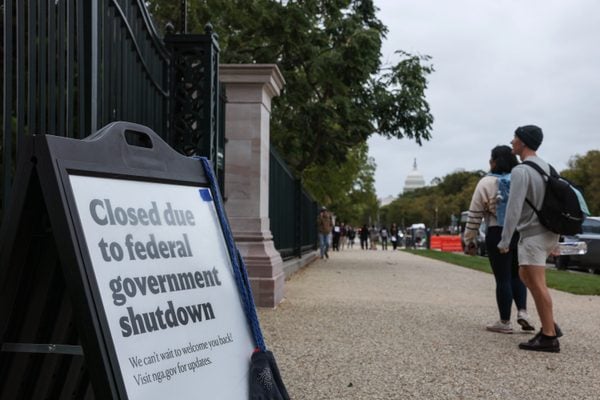
The longest-ever government shutdown
On Oct. 1, the government shut down after Congress failed to approve spending bills or a stopgap. On Nov. 5, it became the longest shutdown in history while Democrats and Republicans remained deadlocked over health care policy.
How it affects Americans: During the shutdown, federal workers were furloughed; benefit programs and financial aid payments were delayed; travel disruptions led to thousands of flight cancellations and increased uncertainty among travelers; and food benefits lapsed for low-income families, straining budgets.
So far in 2026, the dollar has kept sliding and jittery investors are looking to other safe havens such as gold, silver and the Japanese yen.
How it affects Americans: A weaker dollar means people’s money won’t go as far on imported products or when traveling abroad.
How it affects Americans: A smaller trade deficit can make American-manufactured goods more competitive, but it also tends to increase prices on imported consumer goods and contribute to inflation.
Lower — but not that low – mortgage rates
Freddie Mac’s Primary Mortgage Market Survey found the average 30-year fixed-rate mortgage was down from 6.96% on average in January 2025 to 6.09% on average in January 2026 — making current rates some of the lowest levels in over three years.
How it affects Americans: Lower mortgage rates relative to the recent past make buying a home and refinancing existing loans more affordable for many Americans. Spending in the housing market also contributes to economic growth.
After hitting historic lows in 2021, mortgage rates spiked in 2023 and have since declined. Most experts don’t expect to see a return to pandemic-era lows. While rates remain low by historical standards, they’re still high enough to make home ownership unattainable for many Americans.
How it affects Americans: While they last, cheaper gas lowers costs for drivers and reduces transportation and shipping costs, which can help ease overall inflation pressures. Historically, oil prices are volatile and sensitive to factors such as geopolitics, weather events and refinery outages.
A topsy-turvy stock market
Over the past year, the S&P rose broadly by 16.4%, though the gain was slower than the 23.3% increase in 2024.
How it affects Americans: Market volatility is more stressful for households nearing retirement, as well as those who need access to savings. But in the long-term, rebounds support wealth building and retirement accounts.
Increased ICE activity affecting industries
Trump’s immigration policies have been his most divisive, marked by increases in Immigrations and Custom Enforcement (ICE) raids. The increased enforcement has been linked to disruptions in areas of the labor market that depend on immigrant and migrant labor, especially agriculture, construction and hospitality.
How it affects Americans: In addition to raising humanitarian concerns, decreasing a labor pool that is concentrated in key sectors of the economy has serious economic implications. For example, in construction, fewer workers means less housing is built; in agriculture, less food is harvested.
Growth went negative, then rebounded
In the first quarter of the year, the U.S. experienced a period of negative (-0.5%) gross domestic product (GDP) driven by a simultaneous drop in consumer spending and increase in imports as businesses tried to get ahead of tariffs.
But in Q2, GDP turned around (+3.8%) as consumer spending rebounded and importers pulled back on spending. The third quarter also saw positive growth (+4.3%).
Goldman Sachs predicts GDP is likely to rise 2.8% in 2026, a faster increase than in the past two years, but lower than growth spikes in 2020.
How it affects Americans: GDP growth shows the economy is expanding, which typically means jobs are more plentiful, wages are higher and businesses are profiting. Growth is best when it’s steady. Two or more months without growth is, by definition, a recession. But rapid growth can also increase prices and make it more expensive to borrow.
(Lead photo by Kevin Dietsch/Getty Images News via Getty Images)