


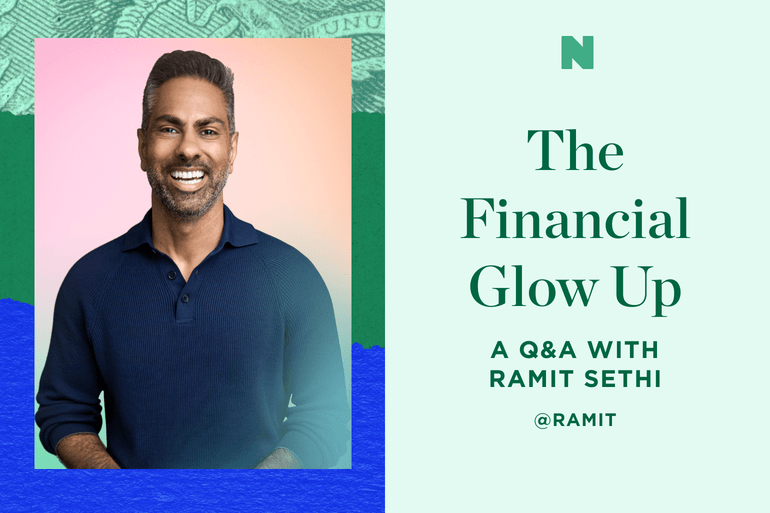
Ramit Sethi thinks “you should be spending less than one hour a month on your money.”
That might feel impossible with bills to pay, expenses to track and savings, debt and retirement to worry about. Nope. Sethi says it’s all about setting up a process and automating what you can.
“Delete your financial apps,” Sethi told me. “You don’t need them if you set your system up right.”
Sethi is full of advice that cuts against the grain on his Netflix show “How to Get Rich,” his “Money for Couples” podcast and his social media channels. He has more than a million followers on YouTube alone, where his most-watched videos challenge conventional wisdom about building what he calls “A Rich Life.”
“You can spend extravagantly on the things you love as long as you cut costs mercilessly on the things you don’t,” Sethi told me.
For example, he said he splurges on travel, clothes and fitness and doesn’t care about fancy cars or high-end dinners out.
His approach fuses psychology with practical money strategies, all aimed at helping people build a life that’s rich in meaning, experiences, and connection.
His online presence stands out to me for another reason: he’s one of the few financial influencers I’ve seen who speaks openly about the political forces that shape our financial lives.
Responses have been edited for length and clarity.
Stop asking ‘Can I afford this?’
Q When you think about a financial glow up what does that mean to you beyond just earning more or saving more?
A: A glow up goes beyond saving an extra $3,000. A true glow up means radically reconceptualizing your relationship with money. That means seeing money as a source of adventure, generosity, and possibility rather than one of scarcity and restriction.
A glow up means mastering your own money psychology. For example, you stop asking, “Can I afford this?” and start asking “What do I want? And how do I use money to get it?”
Q: What is something people can do right now, at the end of the year, to make 2026 better financially?
A: Set up a system once, then let it run on autopilot. Stop logging in every week. Delete your financial apps. You don’t need them if you set your system up right.
Meet MoneyNerd, your weekly news decoder
So much news. So little time. NerdWallet’s new weekly newsletter makes sense of the headlines that affect your wallet.

Q: A lot of personal finance advice focuses on cutting back, while yours emphasizes designing a “rich life.” How do you define that for this moment, especially when costs are up?
A: A rich life can be traveling for two months every year, or buying a beautiful cashmere coat, or picking your kids up from school.
One of the first rich life moments many people experience is not having to look at the prices at the grocery store. Imagine that feeling of joy and freedom!
In my work, I show you how to identify the things you truly love — your “money dials” — and actually spend more on those things.
Stop agonizing over $3 decisions while ignoring $30,000 ones
Q: What inspired your new MasterClass, and what do you hope viewers will take away from it?
A: I got tired of watching people agonize over $3 decisions while ignoring the $30,000 ones. My class teaches people how to master their money psychology, automate their system, and actually enjoy their money. Most financial advice is condescending and filled with shame. Mine is built on freedom, clarity, and action.
Q: For readers unfamiliar with your “Conscious Spending Plan,” how would you explain it in one sentence?
Using our free template, you can instantly see where your finances stack up.
A: I have not seen a single good reason to use BNPL services. If you can’t afford it now, don’t buy it.
I’ve found that many people in debt will do everything except pay off their debt. They’ll play 0% balance transfer games, BNPL, or simply ignore it.
To the couples out there: Don’t get stuck in the numbers
A: Start with a vision of what your rIch life is. It’s too easy to get stuck in the numbers, like how much one person spends at Target.
Instead, zoom up. What do we love? What’s our rich life? Start there, then go deeper into what you want now, in June, and even 10 years from now.
Finally, set up a time to talk regularly about money every single month.
Q: What’s one conversation every couple should have before they move in together or get married — but often don’t?
A: Beyond sharing your actual numbers — income, debt, expenses — ask each other: “What does money mean to you?”
If one of you grew up with scarcity and the other with abundance, you’ll approach spending completely differently. Does money mean you have 12 months of savings? Or that you’ll pay for your kids’ education? Does it mean growth, safety or adventure?
Meet MoneyNerd, your weekly news decoder
So much news. So little time. NerdWallet’s new weekly newsletter makes sense of the headlines that affect your wallet.
Acknowledge ‘money is political’
Q: You’re one of the few personal finance experts I’ve come across who openly talks about politics. Why do you feel it’s important to connect money with political issues?
A: Money is political.
Your housing is expensive because of politics. Health care is expensive because of politics. So is access to education.
Politics is why a guy like me gets an unnecessary, massive tax cut while middle-class and poor Americans have social services cut and more costs thrust onto them.
Some people tell me to “stick to finance.” What they really mean is, “This makes me uncomfortable and I’d rather you just talk about how to maximize credit card rewards.” That’s never going to be me.
My readers want to understand that you can simultaneously acknowledge the need for personal responsibility and the need for systemic change.