

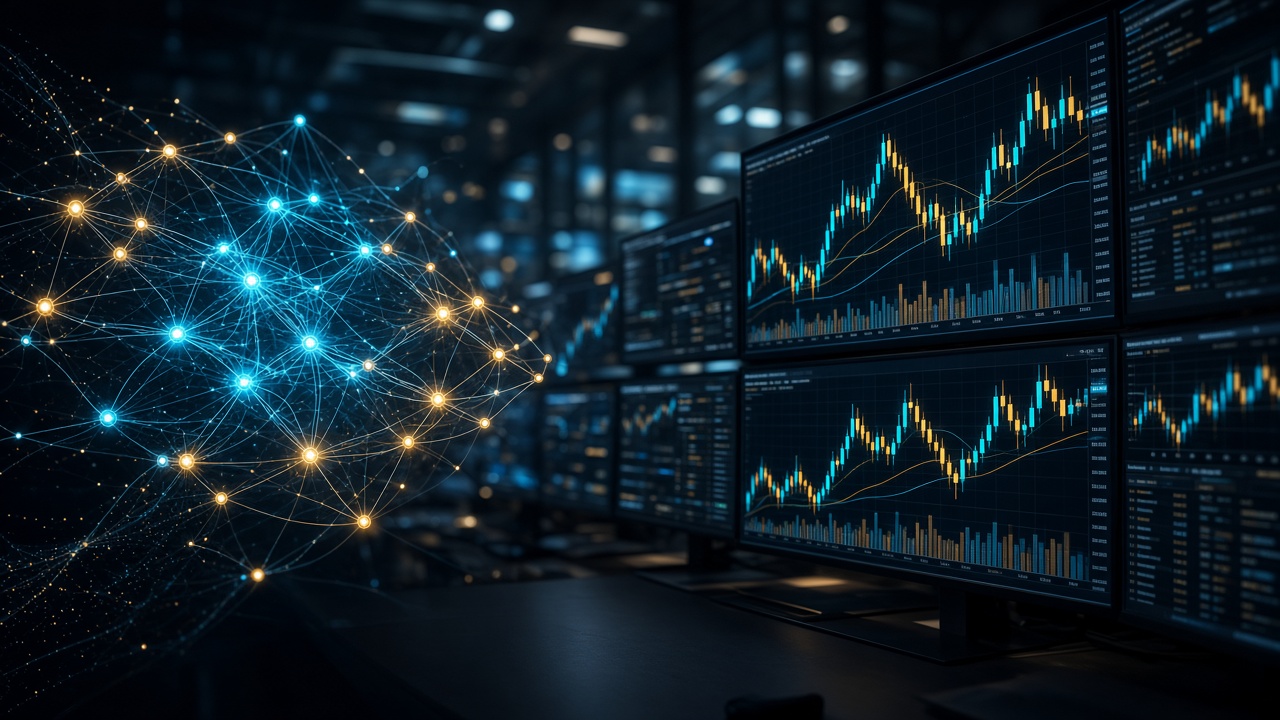
AI agents — software that can plan multi-step tasks, call tools, and act with limited supervision — are arriving on trading desks faster than most retail narratives suggest. The investable story is not “robots replace portfolio managers overnight.” It is quieter: lower research costs, faster anomaly detection, and new operational risks.
Educational analysis only — not investment advice.
What an AI agent means in markets
Unlike a static model that answers one prompt, an agent can:
- Pull filings, prices, and news feeds
- Compare sources and draft research notes
- Route orders or alerts through approved systems
- Escalate exceptions to humans when confidence is low
On regulated desks, agents usually sit behind permission layers, audit logs, and kill switches. That architecture matters more than demo videos.
Where AI agents already create economic value
- Research acceleration — summarizing 10-Ks, earnings transcripts, and central-bank language.
- Surveillance and risk — spotting odd order flow, spoofing patterns, or limit breaches.
- Operations — reconciling trades, coding internal tools, and reducing manual middle-office work.
- Client reporting — turning portfolio changes into clear narratives for advisors.
These use cases show up first in software margins and headcount plans at brokers, exchanges, and data vendors — themes we track in AI and Markets and Fintech.
What investors should watch (signal list)
- Capex and cloud spend at major banks and buy-side firms
- Data licensing revenue from market-data providers powering models
- Latency and infrastructure stocks tied to co-location and networking
- Governance disclosures — model risk, hallucination controls, and human oversight language in filings
- Vendor consolidation — who becomes the default agent stack for compliance-heavy firms
Risks that get underplayed in AI hype cycles
- Model error at scale — a wrong assumption can propagate across thousands of accounts
- Prompt injection and data leakage when agents browse or call external tools
- Correlation risk — many desks using similar models may herd into the same trades
- Regulatory lag — responsibility still sits with the licensed firm, not the model vendor
How this differs from classic algorithmic trading
Classic algos follow explicit rules (VWAP, implementation shortfall). Agents add language understanding and tool use. That makes them powerful for research and ops — and more unpredictable if left unconstrained in live execution.
FAQ
Will AI agents replace human traders?
They are more likely to compress junior research and ops roles first. Discretionary decision rights and accountability remain human in regulated markets.
Is this mostly a U.S. story?
No. Global brokers and asset managers are piloting agents, but adoption speed tracks compliance culture and data quality more than geography.
How can individual investors use this information?
Focus on second-order effects: which companies sell the picks and shovels (data, cloud, security, compliance software) versus who merely mentions “AI” in a press release.
Bottom line
Treat AI agents as a market-structure and productivity story — not a sci-fi trading tip. The winners will combine models with clean data, auditability, and boring but essential risk controls.
IFN Editorial. Read our editorial policy.